Summarize this page with
An anti-detect browser detection API connects collected browser evidence to a result your backend can verify. The essential integration question is whether the event belongs to the account action being protected. A client-reported clean flag, copied event identifier or unrelated recent visit should not become permission to create an account or grant a benefit.
Before choosing an endpoint, define the action boundary and the supported result contract. Some products expose individual signals, some return risk and policy outcomes, and others enforce at the request layer. Those are distinct integration models, even when all appear in the same tool comparison.
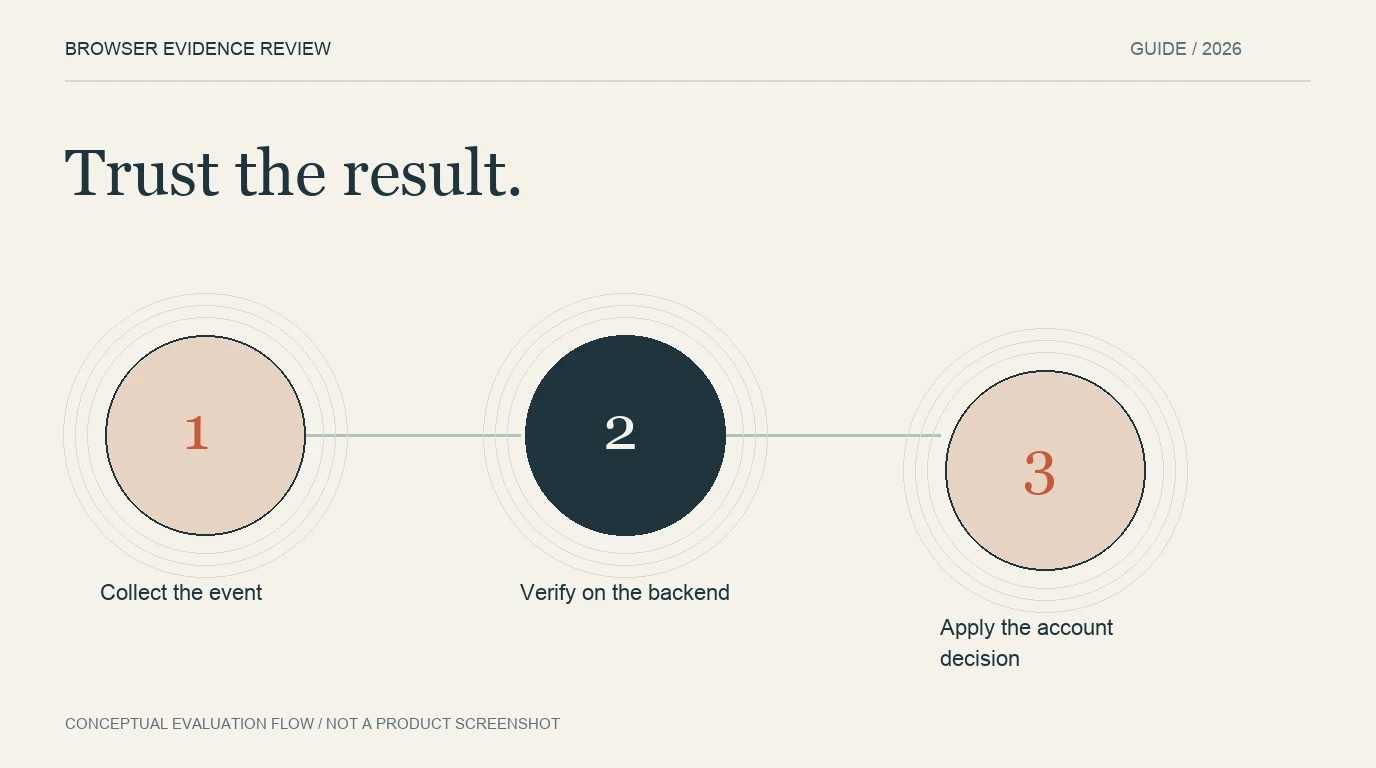
- 1Collect the event
- 2Verify on the backend
- 3Apply the account decision
Design the event association first
Consider an application evaluating a new registration. Browser collection produces an event reference. The application must associate the verified result with the registration attempt and its intended account, rather than accepting any successful event supplied in the request body.
Document which system establishes that relationship, how event freshness is checked and what happens if the user retries. Check the provider’s supported mechanism instead of inventing a universal payload. An event identifier is a reference; its presence alone does not authenticate the user or prove that the reference belongs to this action.
| Integration element | What to verify |
|---|---|
| Collection | Supported client and required page or flow |
| Event | Application/site scope and association to the action |
| Backend retrieval | Authenticated result and documented fields |
| Account decision | Correct account, state and requested operation |
| Investigation record | Result time, reasons and the applied action |
Keep the client and server responsibilities explicit
The client gathers observations under the supported SDK. The server retrieves or receives the authenticated assessment and uses the documented result. Private credentials belong on the backend. A public collection key and a secret server credential serve different purposes and should not be substituted for one another.
For a webhook delivery, verify the provider’s documented authentication, event identity and retry behavior. Do not assume a signature format because another service uses one. For synchronous retrieval, check timeout and rate-limit handling. The correct response contract is the current product documentation for the selected account and integration.
The ShieldLabs product supports API and webhook delivery alongside client and server SDKs. Fingerprint’s Smart Signals documentation describes individual browser and risk outputs. Map either product’s fields deliberately rather than flattening different signals into a single homemade boolean named fraud.
Treat unavailable as a real state
Collection can fail because of an unsupported environment, network interruption, blocked resource or an incomplete assessment. Those cases require an application policy. They do not become clean simply because no suspicious field arrived.
Choose the response by the consequence of the action. A low-impact page view may continue while recording incomplete evidence. A valuable introductory grant may need a retry or an alternative verification route. Avoid an unlimited retry loop that consumes quota while never giving the user a clear outcome.
Distinguish a provider error from a completed assessment with no suspicious findings. Log that difference and make it visible in investigation tools. This distinction also improves your evaluation: technical failures should not inflate the denominator for a claimed detection or acceptance rate.
Separate risk, identity and policy
An identifier helps associate events. A manipulation finding describes the environment. A risk score summarizes the provider’s assessment. A policy outcome determines an allowed response under a particular configuration. An application account is a business record. Keeping these concepts separate makes integrations easier to review and change.
Castle’s documentation is an example of an event and policy-oriented product. Its model differs from opening a diagnostic page and reading a lie count. Use the selected model consistently and keep product-specific score ranges in the record. A 0–10 editorial review score on this site is not an API risk score.
Make retries safe for the protected operation
The application may receive two requests for the same action while waiting for a result. Plan how it prevents duplicate grants, account creation or payouts. Reusing an event response should not make a non-repeatable benefit repeatable.
This is an application-state question as well as a detection question. Record the intended operation, evaluate the trusted result, then perform the permitted state transition once. The exact transaction and idempotency mechanism depends on your application. No generic code sample here is presented as a vendor endpoint or a complete production implementation.
Evaluate the full path before rollout
Use permitted normal, privacy-protected and manipulated environments. Inspect collection, event association, backend evidence and the resulting account state. Include expired references, unavailable results and duplicate requests in the application test plan. A successful SDK import is only one step in that path.
Review operational cost at the same time. Collection events, API calls and protected requests can have different billing units. Use the pricing guide and the vendor’s current plan to budget retries and production volume.
FAQ
Can a browser submit its own clean result?
The protected action should use the provider-supported trusted result and event association. A user-supplied flag is not equivalent to an authenticated server response.
Is a public checker an API integration test?
No. A checker illustrates its own browser observations. It does not verify your account association, server credentials, failure policy or application state transition.
Should every missing result block the user?
Define a response appropriate to the action and available evidence. Keep unavailable results distinct from completed low-risk findings, and provide a usable retry or alternative route where appropriate.
Continue reading
- CreepJS vs BrowserLeaks vs Pixelscan: what each check means
- Headless browser vs anti-detect detection: different signals
Compare all ten tools or read the complete deployment guide.