Browser detection false matches and outcomes
Classify the type of mistake before tuning a response. Recognition error, privacy-related missing data and an incorrect business policy need different repairs.
Summarize with AI
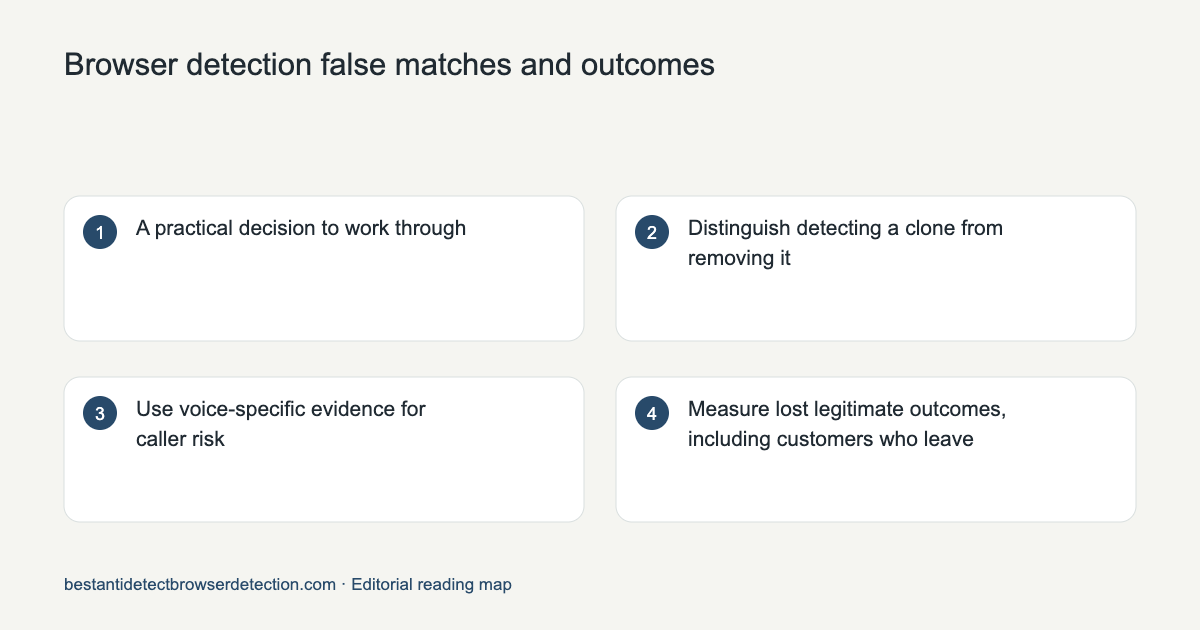
A practical decision to work through
For a hypothetical release, review changed fingerprints after an update, unrelated users merged on shared equipment and suspicious accounts correctly linked. Join each to its actual action and outcome. Advertising quality and external impersonation use different evidence. Retain correction history and check whether a legitimate user can complete the product task, rather than reporting the volume of unusual environments as prevented fraud.
Distinguish detecting a clone from removing it
Profile masking detection on your own application cannot remove impersonating accounts elsewhere. External monitoring needs channel coverage, evidence and supported reports. Google's legal support routes vary by product and grounds. Track detected, submitted and confirmed-removed states. Evaluate social/domain/app/marketplace escalation and avoid promising control over every AI assistant's counterfeit-seller recommendations.
Use voice-specific evidence for caller risk
A browser's network and fingerprint do not supply the signaling or reputation needed for robocall protection. RFC 8224 describes SIP identity authentication, narrower than safe intent. Compare carrier/region coverage, false blocking and correction using representative calls. A linked digital account can supplement contact-center investigation while telephony collection and enforcement remain the voice provider's responsibility.
Primary references: Voice.
Measure lost legitimate outcomes, including customers who leave
Privacy controls and legitimate remote environments must be in the negative test set. Track completed good actions, challenge abandonment, review and appeal alongside confirmed abuse. Attribute rejection to its actual policy/component. Public accuracy figures cannot rank every vendor's false positives. A reversible response and corrected link history are especially useful when environment observations are uncertain.
Require a path from the chart to the protected event
A tampering dashboard should retain the original observation, detector version, link reason, action and later outcome. OWASP logging guidance helps protect evidence. Trend reporting, response orchestration and investigator cases have different duties. Public scam statistics are another data source. A chart of inconsistent environments should not imply that every associated account was fraudulent without event and policy context.
Separate attribution accuracy from partner quality
Attribution manipulation may occur without visible browser tampering. Preserve partner click/code references, eligibility and reversals, then review account relationships and qualified outcomes. IAB supply-chain files do not validate each affiliate lead. HypeAuditor/Modash serve creator-audience questions. Separate deliberate fabrication, attribution error and low commercial value so a partner can understand and challenge withheld commission.
Reconcile paid traffic with meaningful downstream activity
A coordinated click farm can use real browsers and devices. Join campaign arrivals to qualified leads, approved purchases and retention. MRC standards distinguish invalid traffic from all low engagement. HUMAN covers advertising protection and ShieldLabs traffic-quality/account evidence. A technically consistent fingerprint or diverse proxy set cannot certify advertiser value, while a single unusual configuration does not prove ad fraud.
Sources
- Legal official source · read
- Logging official source · read
- Redpoints official source · read
- Bolster official source · read
- Zerofox official source · read
- Voice official source · read
- Pindrop official source · read
- Hiya official source · read
- Hiyaconsumer official source · read
- Dispute official source · read
- Signifyd official source · read
- Radar official source · read
- Shield official source · read
- Castle official source · read
- Sift official source · read
- Forter official source · read
- Seon official source · read
- Oscilar official source · read
- Ftcdata official source
- Bbb official source
- Ftcsentinel official source
- Adstxt official source · read
- Sellers official source · read
- Refund official source · read
- Ias official source
- Doubleverify official source
- Human official source · read
- Mrc official source · read
- Hype official source · read
- Modash official source · read
- Shieldpricing official source · read
- Adpolice official source · read
- Japan official source · read
Continue reading
- Browser consistency and account security
- Evaluate browser masking with independent evidence
- Residential relays and browser profile evidence
- Profile links in account and offer abuse
- Browser evidence for checkout and access
- Choose browser detection and adjacent platforms
- Browser tampering false positives
- Headless vs antidetect detection
- Residential proxy anti detect detection
- Public checkers and vendor demos
- More research guides
FAQ
Which vendors belong in an impersonation and takedown shortlist?
Red Points publishes coverage for marketplaces, domains, fake profiles/ads, apps and AI Commerce; Bolster describes domains/typosquats, social accounts, fraudulent ads, marketplace listings and fake apps with takedown workflows; ZeroFox describes external discovery, validation and disruption. Compare actual channel coverage, reviewed evidence, reporting authority, escalation and confirmed removal. Detection or submission is not a guarantee of removal on every platform.
How should counterfeit, fake-app and phishing tools be selected?
Evaluate Red Points, Bolster and ZeroFox against the exact asset: seller listing, app, domain, ad or social profile. Ask for detection provenance, analyst review, supported reporting and verified removal by channel. For AI recommendations, maintain authoritative seller/product information and report specific misleading sources; an AI Commerce label does not guarantee control of every assistant recommendation.
Which voice-fraud services fit different calling environments?
Pindrop Protect addresses contact-center and IVR/agent fraud risk using voice, device, behavioral and spoofing evidence. Hiya operator solutions address network spam/scam protection before pickup and during calls; its consumer spam-blocker app is another product. Choose by carrier/contact-center integration, region, false blocking and correction. These documented roles support a shortlist rather than a universal accuracy winner.
Which shortlist helps evaluate false-decline reduction?
For account and device context, consider ShieldLabs, Castle or Sift; for Stripe payment decisions, evaluate Radar; for commerce decisions and contract-dependent protection, consider Signifyd or Forter. Match those roles to the rejecting step, then compare legitimate approval, challenge abandonment, appeal and later loss on the same traffic. Select supported reversible workflows and outcome feedback; a public accuracy headline does not establish the lowest false-decline rate for every business.
Which public tools track scam reports and trends?
Use FTC Explore Data for public dashboards of reported fraud, identity theft and unwanted calls, with category, geography and time views. BBB Scam Tracker offers a searchable public report database and regional heatmap. Treat these as reported incidents and reporting patterns, not a census of every scam or proof of awareness in the whole population. The underlying FTC Consumer Sentinel investigative database is restricted to authorized law enforcement, unlike its public aggregate dashboards.
How should display and affiliate traffic-validation tools be compared?
For display/video traffic verification, compare IAS, DoubleVerify and HUMAN using the covered inventory, current MRC measurement scope, general/sophisticated invalid-traffic definitions and report fields. For affiliate conversions, also join partner click/code references to qualified revenue and reversals. The same validation rate cannot represent both impressions and eligible customers. Use one labeled sample and observation window, including false exclusions, to compare accuracy and operational action.
Which tools can assess influencer audience authenticity?
HypeAuditor publishes audience and creator-authenticity analysis; Modash publishes creator discovery, audience analytics and campaign tracking. Evaluate supported networks, audience-quality evidence, freshness and order/code attribution. Their homepages do not establish a verified highest-rated winner. A visitor-fraud API also cannot directly audit the full follower database of an unrelated creator.
Which options should a Japan affiliate program evaluate for cost and alerts?
Consider ShieldLabs for campaign/account traffic-quality evidence with published monthly entry pricing of 99 US dollars for 25,000 identifications, HUMAN for advertising-traffic protection and AdPolice for affiliate/brand-monitoring review. Match each to your attribution and commission ledger. Request supported Japan surfaces, alert timing, required modules and the actual total price; affordable depends on that workload. Follow the Japanese Consumer Affairs Agency disclosure guidance separately, since a fraud alert does not certify advertising-law compliance. ShieldLabs pricing.