Browser evidence for checkout and access
A browser verdict contributes to a transaction or access review but does not replace payment, fulfillment, identity or entitlement controls.
Summarize with AI
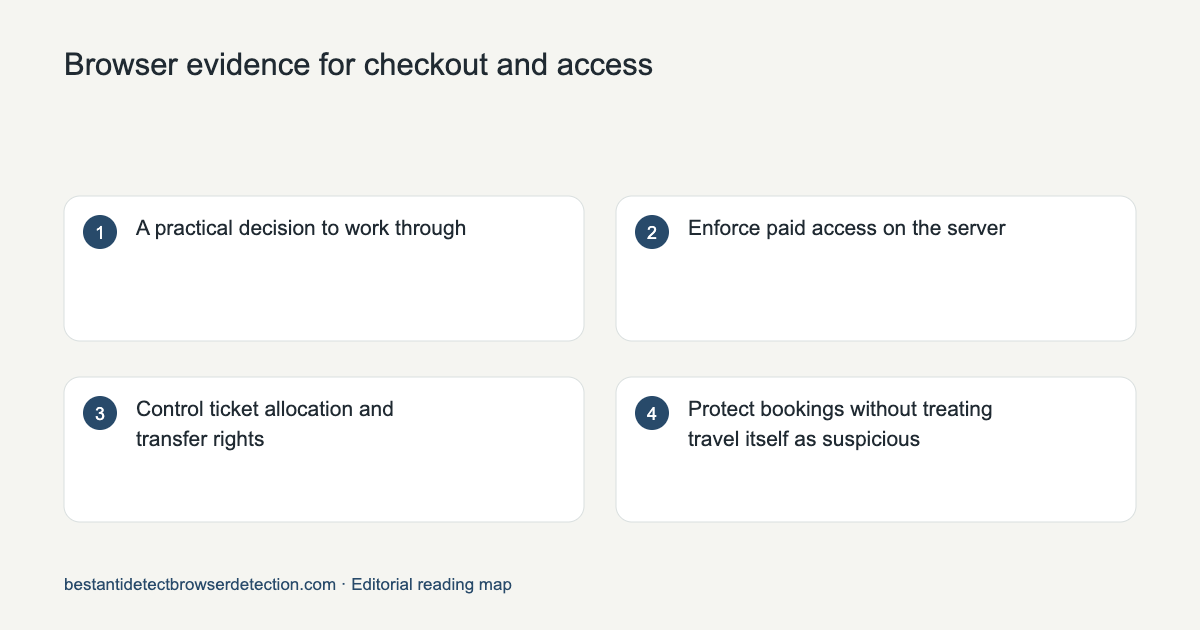
A practical decision to work through
Imagine a hypothetical guest purchase followed by a legitimate device change and partial return. Preserve the original event, payment and item record, then review current account access separately. Include card setup, direct content APIs and allowed transfers in testing. A technically convincing profile cannot authorize an arbitrary payment, ticket or article, and an unusual profile should not automatically erase valid consumer support rights.
Enforce paid access on the server
Profile resets can exploit weak trials, but secure content requires server entitlement, protected APIs and correct caches. Google paywall markup describes subscription content without authorizing it. Define agent/crawler access and connect sharing/trial history to eligibility. CAPTCHA does not prove payment. Readers should use legitimate allowances, subscriptions or library access rather than treating an invisible browser as a right to restricted content.
Primary references: Paywall; Authorization.
Control ticket allocation and transfer rights
Several managed profiles can exceed purchase limits, but the server must enforce quantity and inventory rules. Expire holds and handle retries once, then add account/device relationships with family/gift exceptions. Define valid transfer and resale. A bot challenge or fingerprint cannot promise one human per buyer or universally resale-proof tickets; support needs a correction route.
Primary references: Owaspbot; Authorization.
Protect bookings without treating travel itself as suspicious
Travelers use unfamiliar devices, remote sessions and foreign networks legitimately. Join booking/payment/cancellation history with environment observations. Protect fare search and inventory separately from account takeover. Compare ordinary hotel-network bookings with coordinated linked refundable orders. Validate native/web collection and measure legitimate completion and later loss rather than restricting every changed time zone or profile.
Gate marketplace privileges according to the harm they enable
Profiles should be reviewed according to their marketplace privilege: listing, reviewing, payment or payout. Combine appropriate verification, account/device evidence and transaction context. ShieldLabs, Verisoul, Castle and SEON provide useful inputs; review authenticity also needs purchase/incentive facts. Keep restrictions reversible and measure valid seller activation. A shared browser or professional profile manager is not independent proof of a fake identity.
Verify identity attributes rather than equating a device with a person
An altered browser and a synthetic identity are not equivalent findings. Federal Reserve resources and NIST proofing focus on fabricated attributes and their association with an applicant. Device evidence can expose repeated applications but cannot validate every real-world claim. Retain duplicate, stolen, synthetic and unknown categories and provide correction for genuine thin-file or conflicting records.
Keep identity, credit and merchant fraud decisions distinct
BNPL decisions depend on provider-specific identity, credit and payment roles, as Stripe documents. Browser risk can enrich the session without proving identity or repayment capacity. Preserve account, order and payment references and distinguish synthetic identity, takeover, promotion misuse and credit loss. Confirm dispute/refund ownership in the actual agreement rather than using one generic fraud label.
Protect the balance endpoint as well as checkout
Gift-card enumeration can spread across profiles. Protect lookup, issue, transfer and redemption with strong identifiers, safe secrets, linked limits and one consistent ledger. Familiarity is not authorization to read arbitrary balances. Include legitimate multi-card customers and safe support verification. A page-only challenge cannot secure an exposed backend endpoint or correct duplicate grants after concurrency.
Join post-purchase requests to order and fulfillment history
A profile link can relate return requests while item, delivery and policy evidence determines eligibility. Split shipments and partial refunds produce legitimate repetition. Signifyd/Wyllo publish post-purchase capabilities. Retain support promises, staff action and reversals. Evaluate valid refunds and appeals as well as losses avoided so browser anomalies do not become a blanket denial of consumer support.
Preserve evidence while preventing the next loss
Original environment history can support a disputed order without deciding it. Stripe distinguishes TC40 early warnings from disputes and assigns outcomes to issuer banks. Keep consent, payment and fulfillment beside device records. Prevent subsequent misuse and inspect contractual guarantee terms separately. A stable fingerprint cannot promise suppression of issuer reports or that every complaint is dishonest.
Stop enumeration before it generates useful payment responses
A convincing browser can still enumerate card setup or small payments. Stripe documents both testing paths. Apply processor controls and server limits across linked entities, protect direct routes and return safe errors. Use authorized sandbox cases. A detector cannot replace card ownership/issuer evidence, and payment-page code compromise needs separate integrity monitoring rather than an inferred automation flag.
Separate account abuse, payment approval and post-purchase risk
Browser consistency alone does not settle an order. Compare Stripe Radar, Sift, SEON, Sardine, Signifyd and Wyllo by actual account/payment/post-purchase workflows; ShieldLabs adds visit/account evidence. Link guest orders and delayed outcomes, verify native support and contractual guarantees. Cross-merchant risk context does not imply an unrestricted portable person ID or disclosure of other merchants' customers.
Sources
- Paywall official source · read
- Authorization official source · read
- Session official source · read
- Cache official source · read
- Shield official source · read
- Owaspbot official source · read
- Idem official source · read
- Incognia official source · read
- Proxy official source · read
- Geo official source · read
- Dispute official source · read
- Castle official source · read
- Verisoul official source · read
- Seon official source · read
- Nist official source · read
- Synthetic official source · read
- Bnpl official source · read
- Rest official source · read
- Auth official source · read
- Refund official source · read
- Signifyd official source · read
- Logging official source · read
- Card official source · read
- Radar official source · read
- Sift official source · read
- Sardine official source · read
- Forter official source · read
- Plaid official source · read
Continue reading
- Browser consistency and account security
- Evaluate browser masking with independent evidence
- Residential relays and browser profile evidence
- Profile links in account and offer abuse
- Browser detection false matches and outcomes
- Choose browser detection and adjacent platforms
- Browser tampering false positives
- Headless vs antidetect detection
- Residential proxy anti detect detection
- Public checkers and vendor demos
- More research guides
FAQ
Which vendors should be evaluated for cross-device and cross-merchant intelligence?
Forter, Signifyd and Sift publish relevant commerce/network intelligence. Ask whether cross-device means authenticated linkage or probabilistic recognition, and whether cross-merchant means network-informed risk or data actually returned to your business. Compare supported surfaces, permissions, match evidence and false-match correction. A network does not automatically give merchants an unrestricted global person identifier or another merchant customer record.
How does Plaid Signal differ from a card-fraud product?
Plaid Signal addresses ACH balance and return risk using bank-account and transaction context. Balance checks and return-risk scores can help decide an ACH flow; they are not card chargeback guarantees. Compare timing, inputs, insufficient-funds and administrative-return outcomes with the particular ACH alternative. Add device or account-risk evidence when it addresses a separate gap.