Summarize this page with
A browser tampering finding describes technical evidence; it does not automatically establish an abusive user. Privacy settings, managed browsers, accessibility tooling and software updates can change observable behavior. Evaluate the specific finding alongside account context, legitimate control cases and the consequence of the action before turning it into an access restriction.
The practical goal is to preserve useful detection while keeping genuine users moving. That requires better labels and investigation records, rather than a blanket promise that privacy features always produce low risk or that a particular anomaly always proves intentional spoofing.
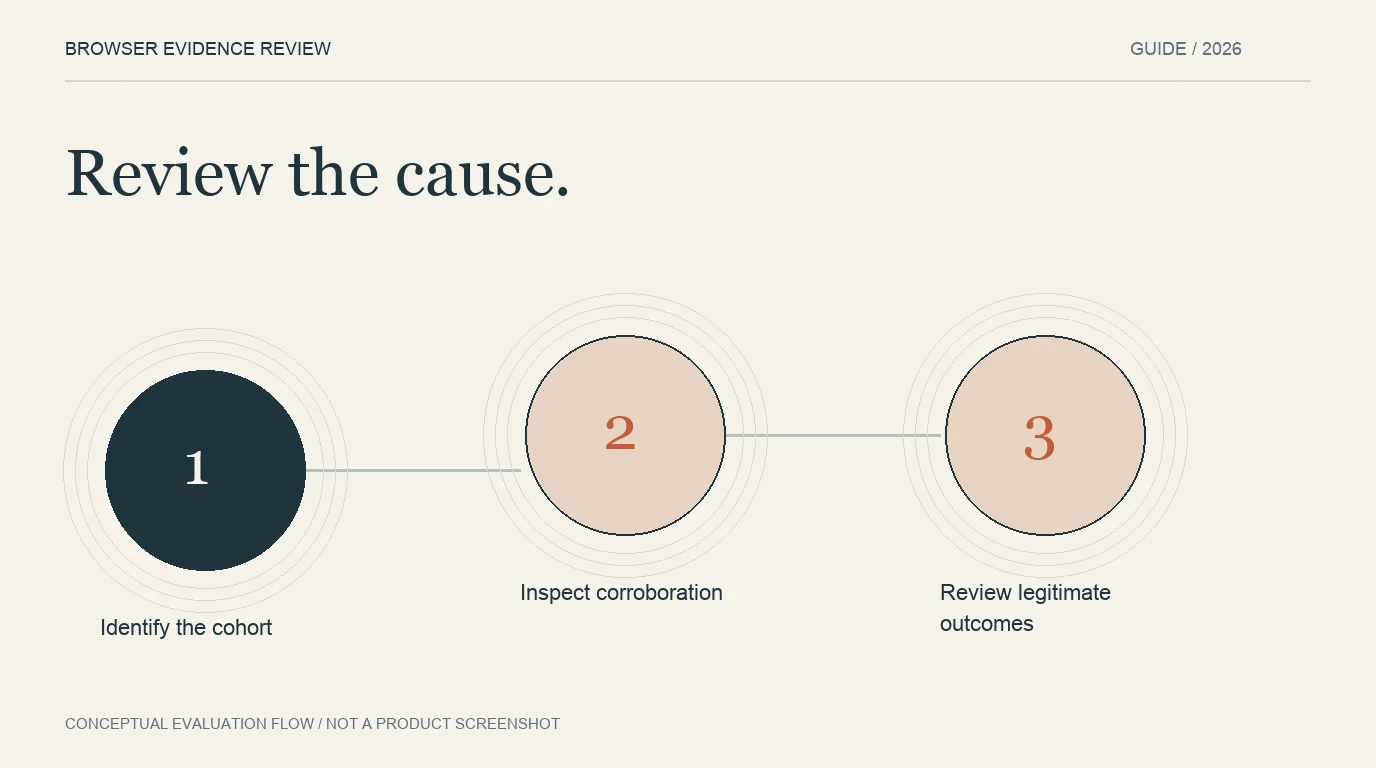
- 1Identify the cohort
- 2Inspect corroboration
- 3Review legitimate outcomes
Define the error before measuring it
Start with the disputed decision.
A technical false positive and an inappropriate business response are related but distinct. A detector might correctly observe a modified environment while the application unnecessarily blocks an authorized customer. Record the observed condition and explain whether the resulting action matched the evidence.
For a signup review, useful outcomes might include a genuine new customer, a permitted agency account, a repeated prohibited benefit claim or an unresolved case. Keep unresolved cases separate. An absence of complaints is not proof that all denied users were abusive; a completed purchase is not proof that every accepted account was legitimate.
Build cohorts that expose the failure
An overall rate can hide problems affecting a smaller supported population. Segment evaluation records by browser family, version, operating system, privacy configuration, managed environment and action type. Use only information that is necessary and permitted under the application’s data practices.
| Cohort | Investigation question |
|---|---|
| Privacy-protected browser | Which supported protection changed the observation? |
| Managed corporate device | Is a policy or extension explaining several findings? |
| Authorized QA automation | Was the session expected and associated with the right test? |
| Returning legitimate customer | Does account history support continued access? |
| Newly changed browser version | Did collection or interpretation change after the release? |
Do not assume all members of a cohort have the same risk. Cohorts make systematic errors visible; they do not replace individual account and event evidence. Browser family is not an intent label.
Cohorts help you find a repeated error; the reviewer still needs the account action and the evidence behind it.
Inspect the cause behind the flags
Fingerprint’s browser tampering documentation distinguishes statistical anomaly detection and anti-detect methods. That distinction matters: an unusual signature is not the same statement as a recognized manipulation pattern. Preserve the original signal and its meaning when reviewing the result.
A managed extension can affect several observable properties together. Treat related observations as potentially connected rather than counting each as independent corroboration. Ask whether another evidence layer supports the decision, and whether a known legitimate configuration produces the same pattern.
The CreepJS repository documents a research diagnostic for fingerprint behavior and JavaScript lies. Its output can help describe a browser condition. It should not be promoted into a universal account-abuse label simply because it contains a score or the word lie.
Choose a response proportional to the account action
A suspicious environment during a low-impact visit and during a valuable benefit claim can require different responses. Define what additional evidence or verification is useful for the action. Repeating the same failed check indefinitely adds friction without necessarily improving the decision.
For an established account, authenticated history and the requested change can help guide review. For a new benefit, prior eligibility and linked activity may matter more. Ensure that an alternative route can distinguish a genuine exception rather than merely restating the original browser judgment.
ShieldLabs provides risk scores, named signals and account-level context. Those outputs give reviewers more to inspect than a browser label alone. The full comparison shows other product models; preserve their own score meanings and supported intervention options.
Keep missing evidence out of the clean group
A blocked collection script, unsupported API or timeout is not a completed negative finding. Record incomplete assessment separately. Otherwise the evaluation can make both detection and customer experience look better by silently removing the difficult cases.
Report completion, findings, applied actions and reviewed outcomes separately. If a cohort has many unavailable assessments, investigate the integration before drawing conclusions about the detector’s quality. The API guide covers result association and explicit failure handling.
Review changes after releases
Browser and detector updates can change observable conditions. Keep evaluation versions and dates so that a new pattern can be connected to a deployment rather than attributed to a sudden change in user intent. Recheck affected legitimate controls when a meaningful update occurs.
A useful operational review asks which group was affected, what evidence changed, what action followed and whether the account outcome justified that action. Keep a dated correction to interpretation when necessary. These records provide stronger guidance than a claim that a detector never inconveniences genuine users.
FAQ
Should every privacy browser be allowed automatically?
No universal browser-based rule replaces the account decision. Privacy settings are relevant context; inspect the actual finding, account state and protected action.
Can a correct tampering flag still lead to a bad decision?
Yes. Correctly identifying a modified environment does not prove prohibited account activity. Review both technical findings and business outcomes.
What should an unresolved case count as?
Keep it unresolved until the review supplies an appropriate label. Do not count missing evidence or an uncertain outcome as either a confirmed clean user or confirmed abuse.
Continue reading
- Detect anti-detect browsers behind residential proxies
- Anti-detect browser detection pricing: compare units
Compare all ten tools or read the complete deployment guide.