Summarize this page with
A residential proxy changes the connection a service sees. Anti-detect browser detection examines evidence about the browser environment. Neither layer replaces the other: an ordinary residential IP does not establish browser integrity, while an unusual browser does not prove the account action is abusive. Evaluate network, browser and application history as separate sources of context.
This distinction matters for products protecting registration, login and repeat benefits. A rule that accepts every residential connection can miss relevant manipulation. A rule that rejects every proxy can inconvenience authorized users without answering whether the same participant is claiming a benefit again.
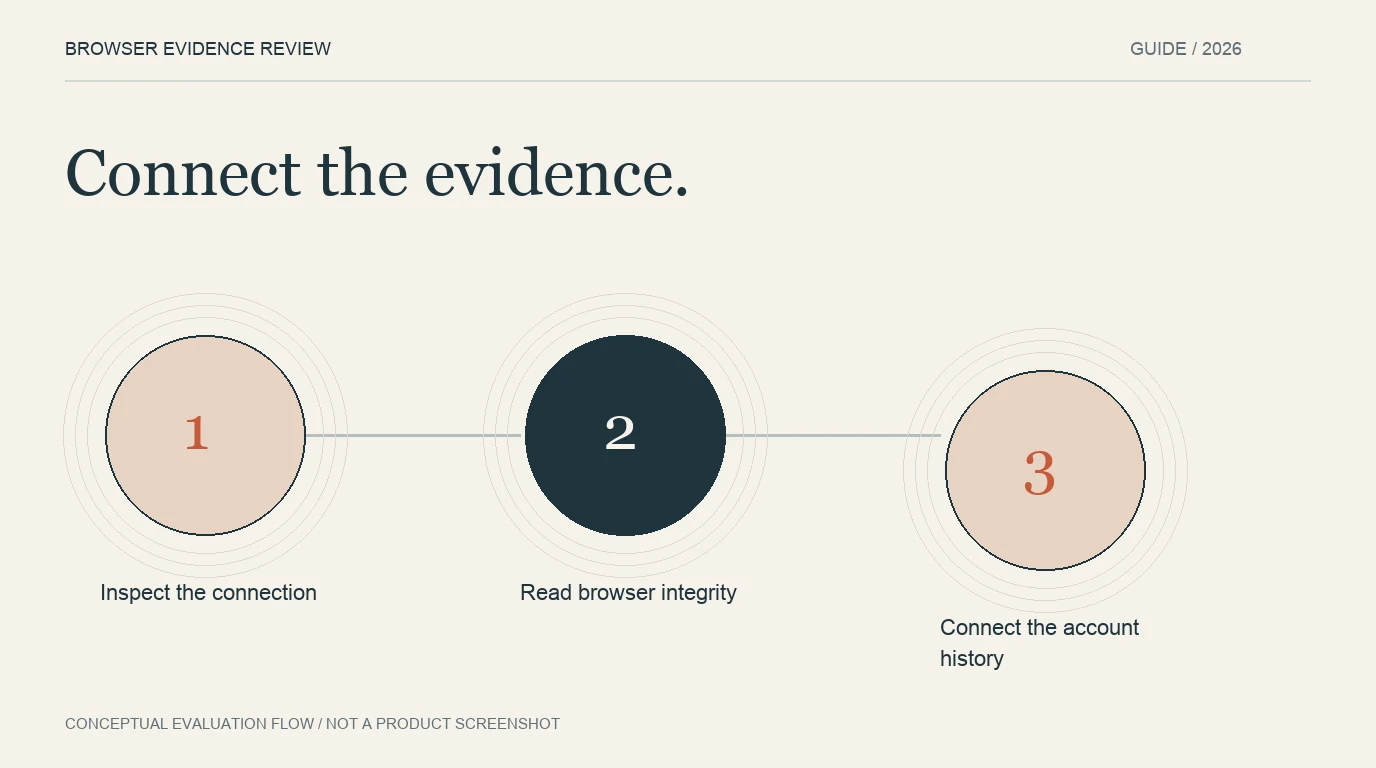
- 1Inspect the connection
- 2Read browser integrity
- 3Connect the account history
Ask what the network result actually describes
IP reputation, connection classification, geolocation and the observed exit address answer different questions. A result about an address should retain its timestamp and scope. It should not silently become a statement about the device, authenticated user or physical person behind a session.
Use the current documented product field. For example, IPQualityScore’s proxy API documentation explains network-oriented assessment. Its separate device product has its own integration. A general lookup quota does not imply access to every browser-detection capability.
Add browser evidence without promising a universal original IP
Browser properties and behaviors can provide evidence independent of a connection’s reputation. A detector may find inconsistency between reported environment values and other observations, or expose specific browser manipulation findings. That assessment remains useful even when the service cannot recover an address beyond the observed exit.
Do not make a leak mandatory for a valid assessment. Browser configuration, platform and collection conditions affect which network observations are available. A missing WebRTC value is not proof of a clean connection, and its absence should not be rewritten as a recovered original IP.
| Evidence | Useful interpretation | Overreach to avoid |
|---|---|---|
| Residential exit | Describes the observed network route | This is a new genuine customer |
| Browser manipulation finding | Describes supported integrity evidence | This proves every action is fraud |
| Additional address observation | Provides connection context where available | Every VPN’s original IP is recoverable |
| Account relationship | Connects permitted application activity | Every shared address is the same person |
Inspect relationships between layers
Timezones, locales and network locations can disagree for legitimate reasons. Travel, remote desktops, employer networks and regional settings can change the apparent relationship. A discrepancy deserves interpretation in context; it does not provide a universal fraud threshold.
For example, a support team investigating a long-lived customer may already know that the user connects through a managed employer environment. An equivalent observation on several new accounts requesting the same benefit raises a different application question. The investigation should state the account evidence supporting any restriction.
ShieldLabs’ device intelligence combines device and network observations with risk context. Its account events provide another layer for reviewing related activity. The ShieldLabs review separates those capabilities from the site’s editorial score.
Preserve the account event when the route changes
An application should keep the authenticated account and protected event association even when the connection changes. Otherwise its investigation record becomes a set of unrelated IP observations. Record the trusted detector result alongside the action it informed, subject to appropriate retention and access controls.
Keep uncertainty about device links visible. A relationship may have a confidence or a defined scope; it is not always deterministic proof of a physical person. Conversely, a new identifier does not establish new benefit eligibility. See multi-accounting across anti-detect profiles for the account-history boundary.
Evaluate legitimate network changes as controls
Use an ordinary permitted session, a permitted alternative connection and distinct-device controls. Record the relevant changes and inspect which findings differ.
Include shared networks and incomplete collection. Compare accepted, challenged and denied actions with independently reviewed outcomes. A test that contains only known manipulated browsers may demonstrate a signal on that sample but does not establish how genuine users will fare in production.
The false-positive guide explains cohort review. The checker directory offers links to diagnostic resources; opening a network checker still does not test the account association inside your own application.
Compare services at the same checkpoint
An IP lookup can be inexpensive because it answers a narrower question. A device identification, a broad fraud check and inline request protection have different outputs and billing units. Choose what the protected action needs, then compare entitled fields, collection conditions and expected volume.
Avoid evaluating two products with different input or account context and presenting the resulting scores as a head-to-head accuracy comparison. A useful procurement record states what each service actually received, which result it returned and whether the application could use that result in time.
FAQ
Does a residential proxy make a browser undetectable?
It changes connection evidence. Browser manipulation, automation and application history remain separate evidence layers whose availability depends on the chosen integration.
Should every proxy connection receive a block?
A connection classification alone does not establish prohibited activity. Define the protected action and consider corroborating evidence and legitimate network use.
Can a browser checker replace a network API?
Their scope and workflow differ. A checker exposes its current test results; a production integration needs supported data, trusted delivery and association with the application action.
Continue reading
- How to detect anti-detect browsers: evaluate the evidence
- Headless browser vs anti-detect detection: different signals
Compare all ten tools or read the complete deployment guide.