Summarize this page with
Detecting multi-accounting across anti-detect profiles requires account history as well as browser evidence. A manipulation flag describes an environment; a device relationship connects observations; repeated prohibited benefit use is an application outcome. Preserve those distinctions so that changed profiles do not automatically appear eligible and shared resources do not automatically merge legitimate users.
Start with the policy being enforced. A product may allow agencies to manage client accounts while limiting introductory credits per eligible organization. Without that definition, the team cannot label a repeated account action correctly, regardless of how sophisticated the detector is.
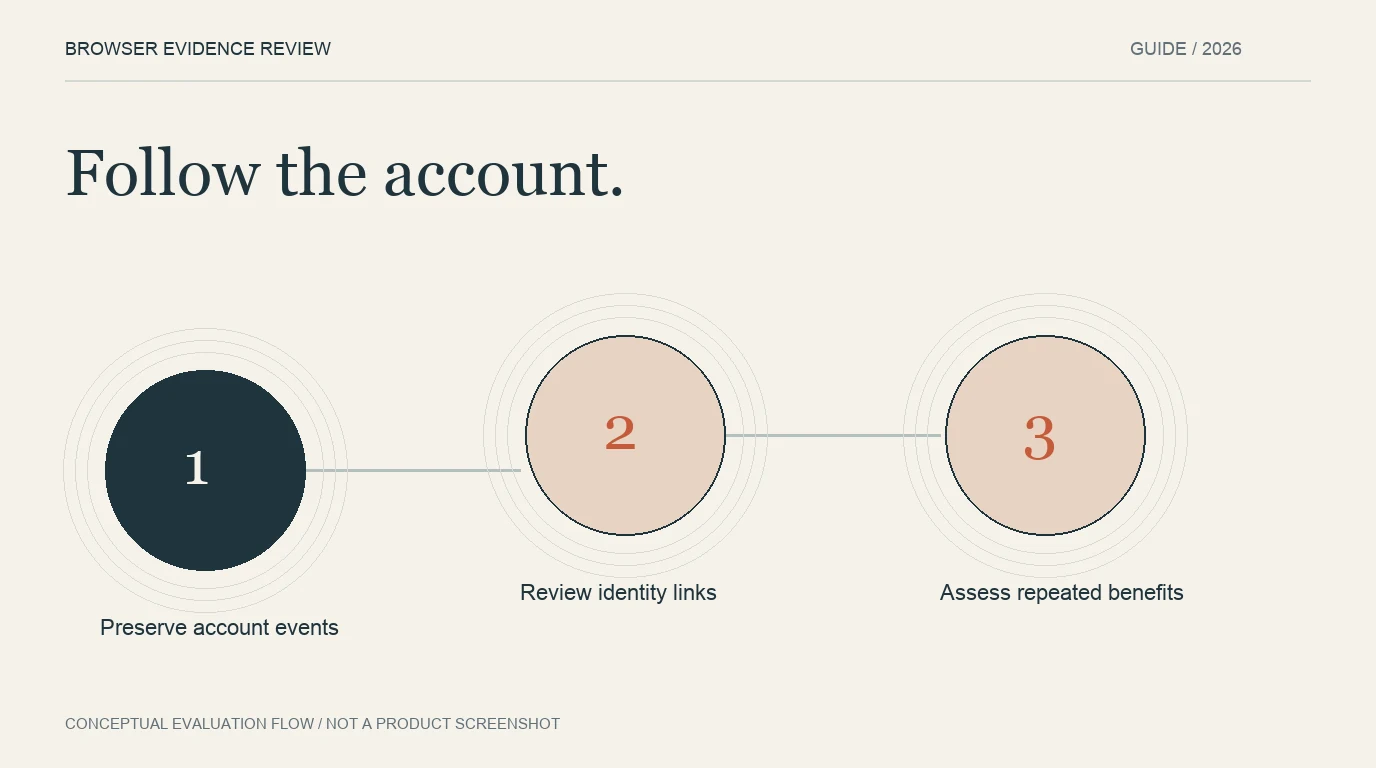
- 1Preserve account events
- 2Review identity links
- 3Assess repeated benefits
Define the unit of eligibility
Write down whether the relevant benefit belongs to an account, person, organization, workspace or another business entity. A device identifier alone does not answer that policy question. Two permitted users may share a device; one participant may use several devices; an organization may have multiple authorized administrators.
Keep the policy record close to the protected operation. The question is whether this action is permitted under the product’s terms, not simply whether a browser has appeared before. That distinction helps reviewers handle exceptions consistently and prevents a fingerprint from becoming an accidental substitute for the business rule.
Preserve relationships with their evidence
Associate the detector’s trusted event with the account and action. Retain the relevant relationship type, time window and supported confidence or score. Do not turn every shared IP into a person match or promote a probabilistic link into a certainty.
| Observation | What it can contribute | What it does not establish alone |
|---|---|---|
| Reused device identifier | Related activity under the product’s identity model | One physical person in every case |
| Manipulation finding | Browser-integrity context | A deterministic match to an earlier profile |
| Shared network | Connection relationship | One eligible participant |
| Repeated benefit record | Prior application activity | The cause of a browser anomaly |
When a new profile cannot be linked confidently, the remaining risk evidence can still inform review. Do not promise that every manufactured profile must resolve to the same device. A new ID and a low-risk environment are separate claims that need their own evidence.
Use ready-made account findings in their stated scope
ShieldLabs combines device/network intelligence with Multi-accounting, Account sharing, Impossible travel and Account takeover findings. The product’s risk score and these events serve distinct roles. Review the named finding and its associated account activity rather than treating every high risk score as confirmed multi-accounting.
Castle’s multi-accounting documentation describes another account-event approach. It should not be represented as lacking ready-made multi-accounting support. Compare supported relationships, event integration, evidence retention and review workflow for your own use case.
The tool comparison retains the published editorial scores while separating production services from manual diagnostics. A checker can show browser evidence; it generally does not know the history of accounts inside your application.
Put the review before the repeated benefit
Map the integration to the state change that matters: issuing credits, accepting a signup bonus, enabling a new trial or restoring access. An investigation recorded after the benefit is repeatedly issued does not prevent that outcome.
The backend should verify the supported result and evaluate the intended action against existing account and eligibility records. Plan safe retries and concurrent requests so the same permitted operation cannot be performed repeatedly while the assessment is pending. The API integration guide explains that boundary without inventing a universal vendor payload.
Include genuine shared-use cases
An evaluation should include permitted agency workflows, shared household devices and authorized staff or QA accounts where they are relevant to the product. Give reviewers enough context to distinguish the intended relationship from prohibited repeated participation.
For example, a marketplace allowing a business to manage several authorized storefronts needs a different eligibility rule from a promotion intended for one new customer. The detector evidence can be similar, while the policy outcome differs. Record why the action was allowed or restricted instead of calling all linked accounts fraudulent.
Do not label legitimacy from one weak outcome. A paid conversion can still follow a prohibited claim, and an abandoned signup may be genuine. Use independently reviewed cases and retain an unresolved group when the evidence does not support a conclusion.
Review a cohort, not a dramatic single case
Track the rate of completed assessments, detected relationships, applied interventions and independently reviewed outcomes. Break the record down by supported environment and use case. Browser and detector updates can change collection; keep their versions and dates.
The useful result is an operational understanding of which evidence supports an account decision, how genuine users can resolve an exception and where uncertainty remains. The false-positive guide provides the next layer of that review.
FAQ
Does a new browser profile prove a new user?
No. A new profile or identifier is not proof of new eligibility. Evaluate the supported device and account evidence alongside the product’s benefit policy.
Can shared devices always be blocked?
Shared use can be permitted. Define the eligibility unit and review the relationship in context instead of applying a universal device-based prohibition.
Is a manipulation finding the same as multi-accounting?
No. Manipulation describes the environment. Multi-accounting concerns related account activity under the product’s model and your service policy.
Continue reading
- CreepJS vs BrowserLeaks vs Pixelscan: what each check means
- Anti-detect browser detection pricing: compare units
Compare all ten tools or read the complete deployment guide.